
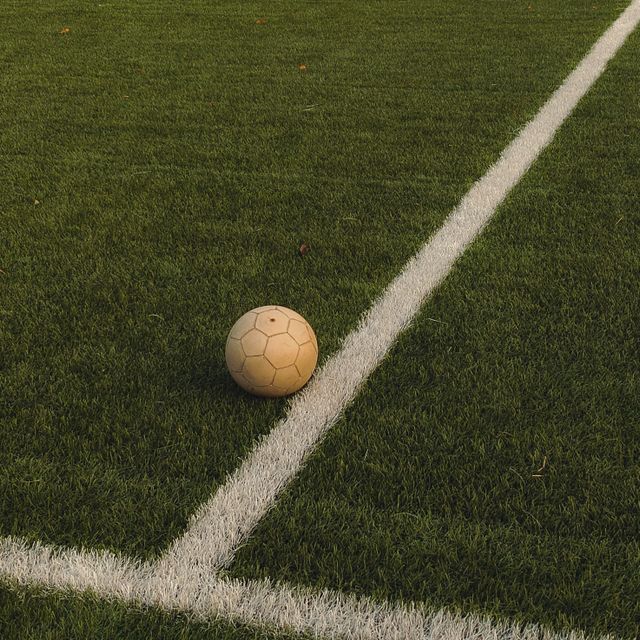
Modern football turf is not simply synthetic grass laid over the ground. It is a coordinated performance system engineered to influence how a player plants a foot, how a ball rolls and rebounds, how quickly rain moves away, and how consistently the surface performs after thousands of hours of use.
This guide looks beneath the green surface to explain the science of a high-performing artificial football pitch, from fiber geometry and infill to shock absorption, drainage, installation, and maintenance.
What makes a football pitch “perfect”?
There is no single perfect surface for every facility. A professional match venue, a school training field, and a high-use community complex have different priorities.
What they share is the need for predictability. Players should be able to trust their footing. The ball should not accelerate, slow, or bounce differently from one area to another. Rain should drain without creating soft spots or standing water, and the surface should remain stable through repeated play.
A well-engineered pitch balances five outcomes:
- Player protection: The system manages impact without feeling unstable or excessively soft.
- Controlled traction: Boots grip during acceleration and cuts without creating excessive rotational resistance.
- Consistent ball behavior: Roll, rebound, and pace remain uniform across the playing area.
- Weather resilience: The base and drainage move water efficiently and remain dimensionally stable.
- Long-term durability: Fibers, seams, infill, and sub-base withstand real usage and maintenance demands.
The engineering principle: A surface can pass a visual inspection and still underperform. The relevant question is not only “Does it look good?” but “Does it respond consistently under load?”
The 7 layers of a modern artificial football pitch
Every design varies by site, intended level of play, and selected turf system, but most modern pitches follow the same systems logic.

Turf fibers
The blades are the player’s and ball’s first point of contact. Their polymer, cross-section, thickness, density, and pile height influence resilience, wear, and interaction with the infill.
Good fibers bend under load and recover repeatedly. More fiber is not automatically better; density and geometry must suit the performance system beneath it.
Performance infill
In filled systems, loose particles support the pile, contribute to impact response, and influence traction, heat behavior, and ball movement.
Material selection is only one part of the decision. Depth, particle shape, bulk density, migration, and compaction all matter.
Primary and secondary backing
The backing holds the tufted fibers in place and gives the carpet dimensional stability. It must tolerate installation stress, temperature changes, drainage, and long-term use without unwanted movement.
Shock pad or elastic layer
A shock pad helps manage impact and can deliver a more consistent response throughout the pitch’s life. Its density, thickness, and stiffness must be matched to the carpet and infill above it.
Compacted aggregate base
The base is the pitch’s structural foundation. It distributes loads, maintains levels, and supports drainage. Even a small deviation below the carpet can become a visible—and playable—high or low point.
Drainage network
Permeable materials and properly positioned drains carry water away from the field. The design should reflect soil, grading, local rainfall intensity, and the rate at which water can leave the site—not only pass through the carpet.
Prepared subgrade
The native ground must be assessed, shaped, and stabilized before the upper system is installed. Poor preparation can lead to settlement and recurring surface defects that cannot be corrected by simply adding infill.
Turf system vs. installed field: why both must be tested

A laboratory-approved turf product is not the same as a certified installed pitch.
Laboratory work evaluates a defined combination of carpet, infill, and shock pad before construction. Field testing then checks whether the completed installation performs correctly in real conditions.
According to FIFA’s stadium guidance, its football-turf program includes three performance levels:
| Program level | Intended context | Typical use profile |
|---|---|---|
| FIFA Basic | Entry-level pitches meeting basic safety and performance criteria | Cost-conscious and development applications |
| FIFA Quality | Municipal, recreational, and community football | Typically 40–60 hours of use per week |
| FIFA Quality Pro | Professional football | Typically up to 20 hours of use per week |
The right target depends on who will use the facility, how often it will be used, and whether formal certification is required. FIFA also notes that compliant products require specific on-site performance testing after installation.

